HOW THIS IS CALCULATED
Seven estimates, each with its own definition of "AGI". Much of the spread comes from that: they answer different questions, from "a system its maker would call AGI" to "every job could be done by machines". The clock counts down to the date each one names; a "not before" bound and your answers' span of years have no countdown. None of them is our prediction. A playful projection, not a prediction.
Lab leaders: end 2026 – 2030
What counts as AGI here: Three heads of AI labs, each with their own bar. Sam Altman (OpenAI): an internal system he would call AGI by the end of 2026. Dario Amodei (Anthropic): “powerful AI”, as smart as Nobel winners in most fields, in late 2026 or early 2027. Demis Hassabis (Google DeepMind): AGI around 2030, possibly 2029. The clock counts to the next of their dates that hasn't passed.
- Sam Altman (OpenAI's CEO), end of 2026: OpenAI is “not quite yet” at AGI, but will have an internal system he would call AGI by the end of 2026 (TIME's paraphrase). His bar is OpenAI's charter: systems that outperform humans at most economically valuable work. TIME, “Inside OpenAI's Reboot”, 26 Aug 2026 · as of 26 Aug 2026
- Dario Amodei (Anthropic's CEO), late 2026 or early 2027: Anthropic told the White House science office: “As our CEO Dario Amodei writes in ‘Machines of Loving Grace’, we expect powerful AI systems will emerge in late 2026 or early 2027.” Powerful AI means, among other things, intellectual capabilities matching or exceeding Nobel Prize winners across most disciplines. No single date, so the clock doesn't count to it. His latest, in June 2026: “If these scaling laws continue for only a year or two longer, we are likely to get what I've called Powerful AI.” Anthropic, recommendations to the White House OSTP, 6 Mar 2025 · as of 6 Mar 2025
- Demis Hassabis (Google DeepMind's CEO when he said it; its chair since Aug 2026), around 2030: Speaking to Axios after Google I/O, he said he still broadly expects AGI around 2030, and now sees 2029 as possible. Axios, “Google DeepMind CEO Demis Hassabis says we're close to AGI”, 26 May 2026 · as of 26 May 2026
Range: end 2026 – 2030 (the spread of the three leaders' dates).
When a leader's date passes, it's marked "passed" and the clock moves on to the next one. After the last, it shows how overdue it is. Hassabis's date is a year, so it counts to 1 January 2030; Amodei's "late 2026 or early 2027" has no single date, so the clock doesn't count to it.
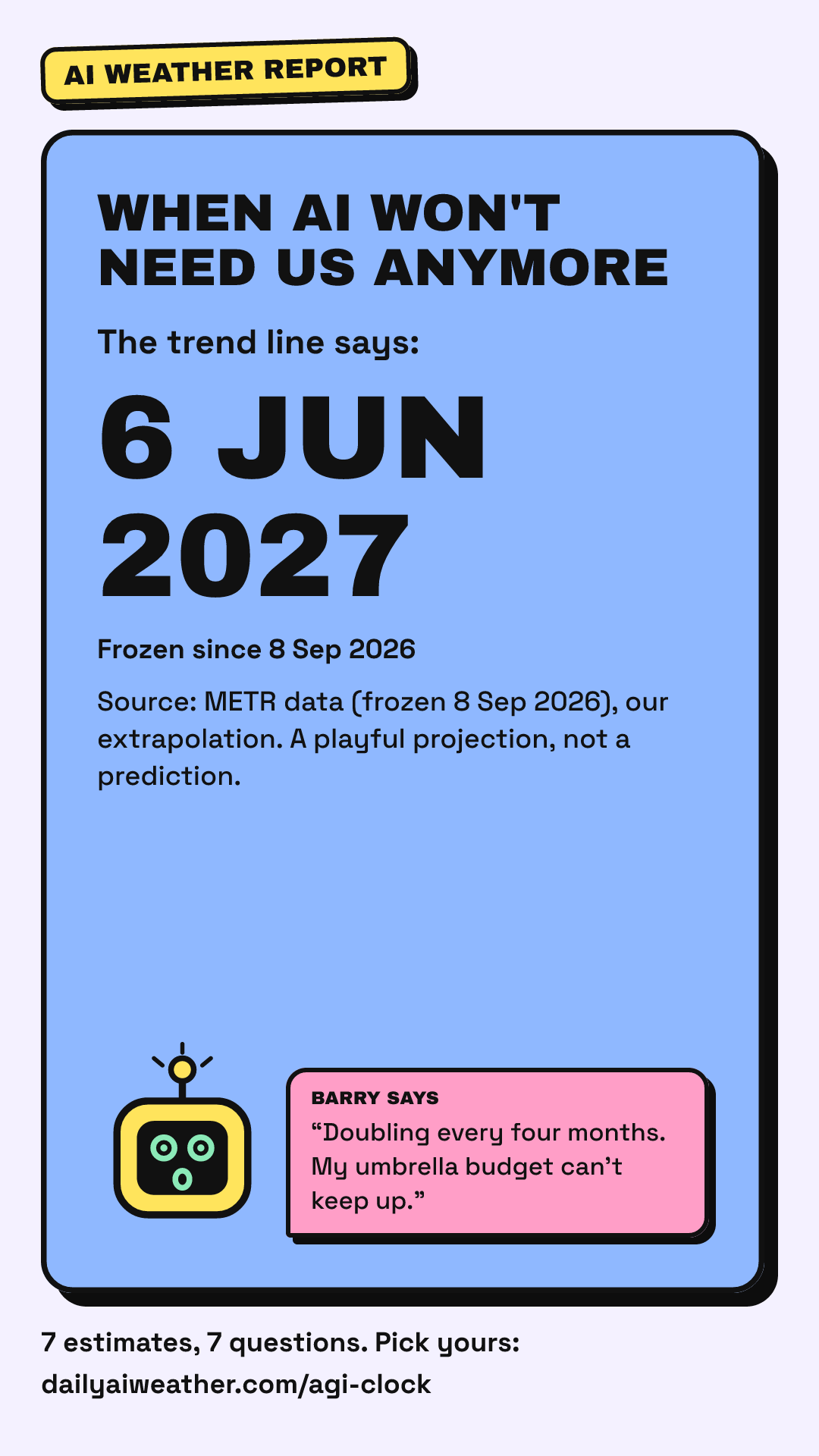
Trend line: 6 Jun 2027
What counts as AGI here: When AI can finish a one-work-month (167-hour) expert software task half the time, if today's rate of improvement holds. Our extrapolation of METR's measurements, not METR's forecast. METR stopped updating them on 8 Sep 2026, and says its measurements above 16 hours are unreliable, which includes the 17-hour starting point.
Range: Mar – Sep 2027 (with the ends of METR's 95% range for the doubling time).
METR measures the longest software task, timed on human experts, that an AI can finish half the time. The best model they measured, Claude Mythos Preview (early) (7 Apr 2026), reached about 17 hours. Since 2023 that length has doubled every 129 days (95% range 104–158 days).
We ask when it reaches 167 hours, one working month:
17 h × 2days ÷ 129 = 167 h → days = 129 × log₂(167 ÷ 17) ≈ 425 → 6 Jun 2027
With the ends of the range: 16 Mar 2027 to 10 Sep 2027. METR stopped updating these measurements in September 2026, and says results above 16 hours are less reliable. A long task length doesn't mean AI can do every job: these are clean, self-contained software tasks.
Source: METR, task-completion time horizons · as of 8 Sep 2026
A skeptic: Not before 2028
What counts as AGI here: Gary Marcus bet Miles Brundage that by the end of 2027 AI won't be able to do 8 of 10 hard tasks the two agreed on, such as writing legal briefs without made-up cases, writing more than 10,000 lines of bug-free code, or a Pulitzer-level book. So, in his view, not before 2028: a lower bound, not an arrival date, and no countdown. On 6 Sep 2026 he wrote that OpenAI's newest model might reach two of the ten, and that he doubted it had hit any of the other eight.
This is a lower bound, not an arrival date, so the clock doesn't count down to it. The dial marks it with a diamond and shades the years after it.
Range: none; a bet gives a bound, not a spread.
Source: Gary Marcus, “Where will AI be at the end of 2027? A bet”, 30 Dec 2024 · as of 6 Sep 2026
Market traders: 31 Dec 2029
What counts as AGI here: The first year by whose end Manifold traders put AGI at 50% or more (play money). AGI here: a system that can understand, learn and apply its intelligence to almost any intellectual task a human can, created and publicly announced; traders judge that themselves.
Range: single date; the source gives no spread.
Source: Manifold, “Will we get AGI before 2030?” · as of 22 Nov 2026
Experts: 2042
What counts as AGI here: The year by which 1,580 AI researchers, on average, give a 50% chance that unaided machines can do every task better and more cheaply than human workers.
The source names a year, so the clock counts to 1 January 2042.
Range: 10% by 2027, 50% by 2042 (the chance researchers give, on average, by each year).
Source: AI Impacts, Expert Survey on Progress in AI 2024 (published Sept 2026) · as of 14 Sep 2026
Superforecasters: 2047
What counts as AGI here: The median year superforecasters on the Forecasting Research Institute's LEAP panel give for when most of that panel will agree AGI exists: a commercially available AI that beats the top 10% of professionals in every mainly non-physical job, on at least 90% of its useful tasks, at no more than 5 times the cost of a person. Asked in April and May 2026; they give it an 80% chance of happening before 2100, and the year assumes it does.
The source names a year, so the clock counts to 1 January 2047.
Range: 25% by 2036, 75% by 2062 (the chance the median superforecaster gives by each year).
Source: Forecasting Research Institute, LEAP Wave 8: Timelines (1 Jun 2026) · as of 1 Jun 2026
Every job: 2098
What counts as AGI here: The same survey of 1,580 researchers, asked a harder question: the year by which they, on average, give a 50% chance that every job could be fully done by machines.
The source names a year, so the clock counts to 1 January 2098.
Range: 10% by 2035, 50% by 2098 (the chance researchers give, on average, by each year).
Source: AI Impacts, Expert Survey on Progress in AI 2024 (published Sept 2026) · as of 14 Sep 2026
The prediction market
Shown as the “Market traders” pin, in place of Metaculus: a set of Manifold markets asking "Will we get AGI before 2027?", "…before 2028?" and so on, by the same creator with the same rules. Each bar is the traders' chance that AGI is announced before 1 January of that year. The pin marks the first year they put at 50% or more: 2029.
What counts as AGI here: a system that can understand, learn and apply its intelligence to almost any intellectual task a human can, created and publicly announced. Traders judge that themselves, so it's looser than the forecasters' test.
- Before 20273%
- Before 202827%
- Before 202946%
- Before 203052%
- Before 203157%
- Before 203264%
- Before 203367%
- Before 203470%
- Before 203568%
Manifold uses play money, so these are bets without real stakes. Markets show what traders believe, not what will happen. Updated every morning; 137 to 354 traders per market.
Source: Manifold, e.g. "Will we get AGI before 2030?" (each year has its own market), republished with permission · as of 22 Nov 2026